Mary Jane Houston, my 2nd great Aunt, was a daughter of John Carrol Houston, one of the first settlers of Eau Gallie Florida. Her mother was Mary Virginia Hall a/k/a Mary Virginia Murray. Her father gave her a dower of land.
On April 6 1897 Mary Houston Young signed away a portion of her dower rights She and her husband, Charles John Young, signed the warrant deed transferring a lot in the Houston addition to Eau Gallie to the Protestant Episcopal Church of the Missionary Juristiction of Southern Florida, for the purpose of building a church already named "St. John's.
They were among the first 29 communicants of St John's Church. They aided and assisted by money and work in building this church. The documents were witnessed by Henry Hodgson and Jno. E.M. Hodgson, Notary Public. The examination of title (search) was made on April 16 1897, and the transaction recorded in Deed Book "B.B." pg 650, on May 1 1897.
Mary and her husand Charles
are buried in the Eau GallieCemetery,
Eau Gallie, Florida
Mary Houston Young was sister to my great grandmother, Ada Louise Houston Roesch. They are all buried in the Eau Gallie Cemetery. Whereas Mary and Charles Young built the St. John's Church, Ada and her husband William Roesch built the St. Paul's Methodist Church.
As the membership grew at St. John's, it became necessary to enlarge the Church. It just amazes me that it was decided to retain to the original sanctuary so the new church was enlarged around it. The old sanctuary is beautiful.
I wish everyone respected history this much.
The Young family moved to Miami about1922, where Charles Young continued to work for the East Coast Lumber and Supply Company.
Christina Jehle, my 3rd great aunt, came to America in 1844 with her husband Johannes Kreitler. They settled in Newark, New Jersey where Johannes, became known as John, owner of "Kreitler's Twine and Rope Manufacturing Company. I know that out of 12 children, at least one of his sons worked at his father's firm.Many German families were settling in Newark. What they found attractive were the 14 German-English schools in the area for their children to attend.
The families may have had varying religious or political views, but they all had strong convictions about preserving the German language for their children. Even the less fortunate class were willing to make any sacrifice to grant their offspring an education in their mother tongue. During this period, over 3700 children were receiving German speaking instruction.
It is 1857 and you are living in Germany. You worked with the underground, the Republican Party, trying to overthrow the monarchy. At first you succeed, but then all is reversed and lost. You have already sent two of your sons to America so they would not be forced to join the German military. Now is the time, you decide, to take the rest of your family and join them in America for a better life.
You gather passports stating that you wish to take up residency in Northern America, publish in the local newspaper of your intentions and that you have paid all your debts, then permission is finally granted with the statement that domestic and civil military authorities are to let you pass.
You hear rumors about young girls being preyed upon by sailors, so you cut your seventeen-year-old daughter's long hair short and change her name so others would think her male. You pack your trunks of clothing, utensils and quilts and food of soft whey cheese and other salted or dried foods and flatbread and kegs of sour milk and beer.
You board the ship "William Nelson" and given accommodations of tween decks, normally used for cargo. You are provided with wide family bunks lined on either side of the ship, one above the other with little room to move about. You have oil lamps that provide you light in an otherwise dark environment, with instructions not to be used during bad weather for fear of fire and orders were issued as to when you must shut them off at night. The captain attempts to foster good health and orders you to take exercise on the top deck.
You and many other passengers, particularly during rough weather, suffer from seasickness and you would vomit on the vessel's wood plank floor. The stench alone caused others to fall ill. On each end of the ship there are long lines to stand in waiting to use one of the primitive oak barrel toilets that contributed to the lingering odor that hung in the air. Despite your queasiness you had to take on some of the responsibility of washing the floor with chlorine and vinegar to help deaden the worst smell. You live like this for 46 long and trying days.
This was the life of my great great grandparents, Mathias Roesch and Magdalena Jehle and their children , Elenora (17), Philip (14), Herman (11), Regina (9), Magdalena (7), Josephine (3), and six month old Maria as they travelled to America aboard the William Nelson.
Mathias later learned that the German government gained a knowledge of the Republican Party and that he got out of Germany just ahead of them.
About the William Nelson
The US ship was built in Somerset, Massachusetts in 1850. It sailed its last voyage from the port of Antwerp on June 1st, 1865. On the 25th of June 1865 the ship caught fire, burned and sank with 426 German and Swiss immigrants aboard. The captain and his crew were the first to abandon the ship. Men woman and children were left to fend for themselves and die in fiery misery and confusion.
I placed flowers on every ancestor
in the Eau Gallie Cemetery
Mary Houston, my great Aunt, was a daughter of John Carrol Houston, one of the first settlers of Eau Gallie Florida and Mary Virginia Hall. On April 6 1897 Mary Houston Young signed away her dower rights to a portion of land she had received from her father.
She and her husband, Charles John Young, signed the warrant deed transferring a lot in the Houston addition in Eau Gallie to the Protestant Episcopal Church of the Missionary Jurisdiction of Southern Florida, for the purpose of building a church already named "St. John's. They were among the first 29 communicants of St John's Church. They aided and assisted by money and work in building this church. The documents were witnessed by Henry Hodgson and Jno. E.M. Hodgson, Notary Public. The examination of title (search) was made on April 16 1897, and the transaction recorded in Deed Book "B.B." pg 650, on May 1 1897.
Mary Houston Young was sister to my great grandmother, Ada Louise Houston Roesch. They are all buried in the Eau Gallie Cemetery. Whereas Mary and Charles Young built the St. John's Church, Ada and her husband William Roesch built the St. Paul's Methodist Church.
As the membership grew at St. John's, it became necessary to enlarge the Church. It just amazes me that it was decided to retain to the original sanctuary so the new church was enlarged around it. The old sanctuary is beautiful.
My great grandmother, Elsie Lovina Eldridge, left a half sheet of paper listing our descendants back to an Ann in history. That was the only explaination she gave. The only famous Ann our family could think of was Anne Marbury. But I had a difficult time following the trail she had left behind until one day it finally connected and was quite amazed to discover that yes indeed, she was my 9th great grandmother.
How I descend from Anne:
Decendant of Anne Marbury
1. Anne Marbury 1591-1642
+William Hutchinson 1586-1642
2. Susanna Hutchinson 1633-1713
+John Cole 1625-1707
3. Susanna Cole 1656-1726
+Lieutenant Thomas Eldred 1648-1726
4. Captain John Eldred 1670-1741
+Mary Greene 1682-1747
5. Samuel Eldred 1710-1778
+Susannah Casey 1714-?
6. Henry Eldridge 1758-1825
+ Elizabeth Tanner 1752-1844
7. Josiah Tanner Crandall Eldridge 1782-?
+Elsie Lewis 1785-1852
8. Loomis Eldridge 1829-1872
+Eliza Benson 1835-1880
9. Elsie Lovina Eldridge 1870-1961
+Emond Lewis Sterling 1869-1953
10. Florence Eloise Helen Sterling 1904-1971
+ William Phillip Roesch 1893-1960
11. Elsie Louise Roesch 1927- still alive
+ Robert Franklin Smith 1923-2008
12. Kathryn Marie Smith 1944-me
+ Merrill Cecil Lockhard 1940-my hubby
Anne's history is rather lengthy, but a most remarkable one. I am proud to call her grandmother. (Information taken from historical records.)
Anne MARBURY, my 9th great grandmother, was the daughter of Reverend Francis MARBURY and Bridget DRYDEN, and was born in 1591 in Alford, Lincolnshire, England. She married William HUTCHINSON, a merchant, 9 Aug 1612 in London. She and her husband came to America in 1634 with Reverend John Lothrop's group on the ship "Griffin" and settled in Boston.
No stranger to religion, Anne grew up during the persecution of the Catholics and Separatists under Elizabeth and James I. Her father, Rev. Francis Marbury, had been imprisoned twice for preaching against the incompetence of English ministers, though he later became the rector of St. Martin's Vintry, London, rector of St. Pancras, Soper Lane, and finally rector of St. Margaret's, New Fish Street. He was holding two of these offices simultaneously when he died in 1611.
Anne began her involvement with religion quite innocently, using her intelligence to interpret the only book available to her - the Bible. She had followed her beloved minister, Reverend John Cotton, whose removal to New England a year earlier had been "a great trouble to me...I could not be at rest but I must come hither."
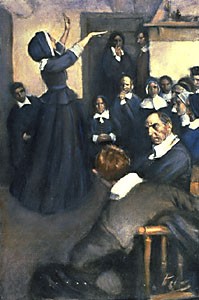
Anne Preaching
The religious climate in the Massachusetts Bay Colony was oppressive. As the colony took hold, ministers emphasized everyone's pious duty to pray, fast and discipline oneself. Noting that the male members of Boston's church met regularly after sermons to discuss the Bible, she started to hold similar meetings for women in her own home. At first the women discussed the previous Sunday's sermons, but before long Anne began telling them of her own beliefs which differed from those of the Boston ministers. She attracted hundreds of women - aided by her reputation as a skilled midwife - and men, too, soon joined her discussion group.
Brilliant, articulate and learned in the Bible and theology, she denied that conformity with the religious laws were a sign of godliness and insisted that true godliness came from inner experience of the Holy Spirit. Anne further exacerbated the local elders by claiming that only two Boston ministers were "elect" or saved, John Cotton and her brother-in-law, John Wheelwright.
Anne's weekly meetings took on a new importance. As many as eighty people filled her house, including "some of the magistrates, some gentlemen, some scholars and men of learning." Among them was Sir Henry Vane, who became governor of the colony in 1636. When Anne, with the aid of Governor Vane and John Cotton, attemtped to have her brother-in-law, John Wheelwright installed as minister of the Boston chuch, most of the congregation supported her. But the pastor of the church, Reverend John Wilson, gave a speech on the "inevitable dangers of separation" caused by the religious dissensions, and joined with John Winthrop in opposing her.
What started as a religious point of difference grew into a schism that threatened the political stability of the colony. To her opponents, questioning the church meant questioning the State. Anne's ideas were branded as the heresy of "Antinomianism" (a belief that Christians are not bound by moral law), and her followers became known as "Antinomians". Intended to be derogatory, the term was erroneously applied to Anne's followers, who did not believe that the inner Holy Spirit released them from obligation to moral law.
The colonial government moved to discipline her and her numerous followers in Boston. In May 1637, Vane lost the governorship to John Winthrop. To prevent new Antinomians from settling, he imposed a restriction on immigrants, among them Anne's brother and several of her friends. In August, eighty-two "heresies" committed by the Antinomians were read at a synod, and a ban was placed on all private meetings.
But Wheelwright continued to preach and Anne now held her meetings twice a week. In November, Winthop appearing before him, and though I must come to New England, yet I must not fear nor be dismayed," she said. "Therefore, take heed. For I know that for this that you goe about to doe unto me," she threatened, "God will ruin you and your posterity, and this whole State." Winthop immediately replied, "I am persuaded that the revelation she brings forth is delusion." The court voted to banish her from the colony, "as being a woman not fit for our society".
Anne on Trial
Wheelwright was exiled and shortly left for New Hampshire while Anne was put under house arrest for the winter to await a church trial in the spring. On March 15, 1638, Anne was brought to trial before the elders of the church of Boston. When her sons and sons-in-law tried to speak on her behalf, John Cotton cautioned them against "hindering" the work of God in healing her soul. To the women of the congregation he said to be careful in listening to her, "for you see she is but a woman and many unsound and dangerous Principles are held by her."
Once her friend, Cotton now turned full force against her, attacking her meetings as a "promiscuous and filthie coming together of men and women without Distinction of Relation of Marriage," and accused her of believing in free love. "Your opinions frett like a Gangrene and spread like a Leprosie, and will eate out the very Bowells of Religion."
Then Reverend Wilson, whom she had once tried to evict from the Boston church, delivered her excommunication. "I doe cast you out and in the name of Christ I doe deliver you up to Satan, that you may learne no more to blaspheme, to seduce, and to lye."
"The Lord judgeth not as man judgeth," she retorted. "Better to be cast out of the church than to deny Christ."
Anne being Bannished
Banished from Boston, Anne Hutchinson with her husband, children and 60 followers settled in the land of Narragansetts, from whose chief, Miantonomah, they purchased the island of Aquidneck (Peaceable Island), now part of Rhode Island. In March, 1638 they founded the town of Pocasset, the Indian name for that locality; the name "Portsmouth" was given to the settlement in 1639. Here they established that colony's first civil government.
After William's death in 1642, Anne took her children, except for five of the eldest, to the Dutch colony in New York. But a few months later, fifteen Dutchmen were killed in a battle between Mahicans and the Mohawks. In August, 1643 the Mahicans raided the Hutchinson house and slaughtered Anne and five of her youngest children. Only one young daughter who was present, Susanna who was taken captive, survived. (Note: Many older sources insist that ALL of Anne's children except her daughter, Susanna were killed with her. This is simply not true. Sons Edward, Richard and Samuel were not present, nor were her eldest daughters, Faith and Bridget, most of whom left numerous descendants.)
The site of Anne's house and the scene of her murder is in what is now Pelham Bay Park, within the limits of New York City, less than a dozen miles from the City Hall. Not far from it, beside the road, is a large glacial boulder, popularly called Split Rock from its division into two parts, probably by the action of frost aided by the growth of a large tree, the stump of which separates the parts. The line of vision of one looking through the split towards Hutchinson River at the foot of the hill will very nearly cross the site of the house. In 1911 a bronze tablet to the memory of Mrs. Hutchinson was placed on Split Rock by the Society of Colonial Dames of the State of New York, who recognized that the resting place of this most noted woman of her time was well worthy of such a memorial. The tablet bears the following inscription:
Birthdate:
Birthplace:
Alford, Alford Parish, Lincolnshire, England
Death:
Died in Pelham Bay, Long Island, New York, USA
Cause of death:
Killed by Indians
Occupation:
Midwife, Religous Reformer; expelled frm MA in 1637, Banished from Mass Bay Colony 1638, Puritan preacher, came to New England in 1634, midwife / lay physician
ANNE HUTCHINSON
Banished From the Massachusetts Bay Colony
In 1638
Because of Her Devotion to Religious Liberty
This Courageous Woman
Sought Freedom From Persecution
In New Netherland
Near This Rock in 1643 She and Her Household
Were Massacred by Indians
This Table is placed here by the
Colonial Dames of the State of New York
Anno Domini MCMXI
Virtutes Majorum Fillae Conservant
April 1996 , In April, 1996, Anne Hutchinson was honored by the dedication of a plaque which appears in the photo. It was placed at Founders Brook Park on Aquidneck Island (Portsmouth), Rhode Island. The plaque is the work of the Anne Hutchinson Memorial Committee, a g
Some twentieth century observers credit Anne Hutchinson with being the first American woman to lead the public fight for religious diversity and female quality. In his 1971 biography, Eleanor and Franklin, Joseph P. Lash reported that Eleanor Roosevelt began her list of America's greatest women with Anne Hutchinson. Anne did indeed use her considerable influence as a woman to test the Massachusetts Bay Colony's religious tolerance which, ironically, had been the reason for the settlement.
Phillip Osborne Roesch loved repairing radios as a young man with Buzz Creel and he always remained curious about how they worked. Being the intelligent man that he was, Phil built upon his experience working in maintenance and repair of the electrical systems in the Oleander hotel that sat on the corner of Pineapple Avenue and Eau Gallie Boulevard.
All his past experience prepared him for the most interesting and challenging job of his lifetime. In 1951, at the age of 34, he obtained a position with RCA, a subcontractor for NASA, working at Patrick Air Force Base in Cocoa Beach, Florida. In seeking out an explanation of what he did, Phillip replied as if it could be understood, "I calibrate the equipment used to calibrate the monitoring instruments that are used to record the missile telemetry and other in-flight information and support activities."
It was always a top secret when and what time military missiles were to be launched. NASA certainly didn't want the Russians knowing this information or anyone else that might have an interest.
Base Where Phillip Worked
A very rare picture of Phil at work
Phil was involved with Cape Canaveral from the very early beginnings of space exploration. There were various times he would be sent "down range" to Antigua, West Indies; Grand Turk, Ascension and other islands to monitor missile activities in that corridor. Part of the monitoring was to pinpoint the recovery location of early pre-man missions of returning monkeys. The first to return home safely on May 28, 1959 were Able, a rhesus monkey, and Miss Baker, a squirrel monkey. These animals were launched to study the biological impact on man during space flight.
One page out of three of his resume
It was on May 5, 1961 the first manned Mercury spacecraft lifted off with Astronaut Alan B. Sheppard that lasted a total of 15 minutes. These missions took place during Phil's first 10 years of employment. Phil, as Communication Manager, ultimately supervised a staff of 19 technicians and radio operators, directly in maintenance and operation in a number of communication center facilities.
It was after the great depression that the grandfather I never knew, William Phillip Roesch (1893-1960) known as Bill became a county police officer. During this period he drove a motorcycle and would give his daughter Elsie (my mother) rides in the sidecar.
During prohibition, there was little enforcement of an unpopular federal law to shut down moonshine operations. But, as soon as a tax was to be collected on whisky, enforcement became more profitable for the local governments.
Shutting down Moonshine Operation
Bill eventually became a sheriff's deputy and in that capacity closing down moonshine operations was one of the many duties he performed.