In 1934 a child of age seven listens to adults talking, "He's nothing but a horse thief". What does that mean? Fast forward to 2017. This child, my mother, is approaching 90 years of age. We had spoken many times over the years and yet I couldn't find anything on this story. I just came to conclusion it meant something like he was a bum, and forgot about it.
The "Horse Thief" was married to one of my great grandmother's sisters. But which one could it be, Ada or Cora? I knew the name of Cora's husband but had no idea who Ada had married. That is until a few months ago when I was contacted by a person who claimed to be related to this family. (Met another cousin)
I asked her about the rumor of a horse thief. She quickly replied, no rumor, it's true, and she forwarded the newspaper articles, prison records and obits.
Ada "Addie" Eldridge, (1859-1934) my great aunt, married John J. Milliman, (1856-1935) a farmer and horse trader. They were from New York.
Here is that story:
May 24, 1879, Nunda News, Nunda, Allegany, NY
A Gang of Thief's Have Infested the Neighboring Towns.
William Dunigan, Breman Cutler, John Dunigan and John Mess were arrested on the charge of larceny. On the examination of the prisoners, evidence was brought out implicating the Milliman Brothers. John, Jim and Myron of Loon Lake. They were arrested and taken to jail.
The first men arrested turned states evidence, naming John Milliman, the leader of the gang. John was charged with grand larceny, found guilty and sentenced to three years to Auburn prison.
Myron Milliman was sentenced to Buffalo work-house for seven months and fined $150. His brother Jim was fined $50 and four months in the same place.
The article ended saying: It is to be devoutly hoped that the bringing of the outlaws to justice will break up the gang which has for years been a terror to the law abiding citizens of this and neighboring counties.
I'm grateful that no one in my family was injured when this large truck crashed into my grandparents business and took the gas pumps out as well as the awning that covered them. If my great grandfather, grandfather, grandmother was pumping gas, they would have been killed. It was also not uncommon for customers to be standing nearby or even children playing for the main house sat right next door. I'm surprised that there was no fire or explosion.
They way it looked when first built.
My mother is the little girl watching her grandfather pump gas.
Sarah Beebe, my 2nd great grandmother was born in Cuba, New York on Beebe Hill on July 4, 1845. She was the daughter of Royal Beebe and Mary Ann Woodward.
She married Lewis Sterling on the 4th of July 1865 at Clarksville, New York. Apparently it was a tradition for she was not the first Beebe to marry on this date. Other family celebrations occurred on this date as well.
Her husband Lewis was a Sargent in the Civil War. He served from 1861 to 1863, a period of two years.
Sarah died on February 22 1917 at her daughter's, Ermina, home. She was buried in Union Settlement Cemetery, Oswego County New York.
It was in her obituary that I made the discovery of a son, Arthur Loomis Sterling, that our family was unaware of. His brother Emond, my great grandfather never mentioned he had a brother. After careful research and help from a Good Samaritan, this is what I found.
Taken from the Olean Times-Herald
March 25, 1933
For Accident Victim Held At Portville
March 25 —Funeral services for Arthur Sterling. Buffalo, who died Sunday in the Buffalo City Hospital from injuries received in an auto accident, were held this afternoon at two o'clock from the home of his sister, Mr. and Mrs. Everett Eldridge, Brooklyn Street. The Rev. George F. Loehr. pastor of the Presbyterian Church, officiated. Burial was in Main Settlement Cemetery.
Mrs. Sterling was also injured in the accident which happened Thursday in Buffalo. She is a patient in the City Hospital. Surviving, besides his wife, are a daughter, Mildred Austin, of Eldred, Pa, sister, Mrs. Ermina Eldridge of Portville, NY, a brother, Emond Sterling, of Eau Gallie, Fla.
My grandmother, Florence Sterling Roesch Hilligoss and step-grandfather, Virgil Scott Hilligoss, known as Scott) are buried in the beautiful grounds of the Florida Memorial Gardens in Rockledge, Florida. (Scott was the only grandfather I knew, since the day I was born) and I loved him dearly.
My great grandparents urns, Elsie Eldridge and Emond Sterling, were placed at the foot of their daughter's casket, with permission from the cemetery, but sadly they would not allow their names to be displayed.
This necklace is designed with three strands each braided a little different. In the center is a seabean that was found washed up on the Florida beach that had made its' way from the Bahama's. It was polished and attached to the strands with a decorative 18K gold clasp.
Her hair was the color of chestnuts. She kept it long and wore it braided and wrapped over her head. It belonged to my great grandmother, Elsie Lovina Eldrige Sterling and this necklace was made from her hair. I called her gram and I loved her dearly. She passed away when I was a senior in high school.
In 2022 I passed this special necklace on to my daughter, Kimberly.
This black sheep will have to remain anonymous, because it is an entity that is still in business. Most likely the individual that did this to my family years ago, around the time of the depression, is no longer with us. The strange thing is, nothing was ever spoken of it, and the parties who were also neighbors remained kindly to one another, at least face-to-face.
Restaurant on the left
Gas Station on right
My grandmother, Florence, ran a dining room that was a regular stop for truck drivers. As a matter-of-fact, one of the truck drivers would let my mother, at the of twelve, drive his truck about 1000 yards up the road, stop and let her out. She would then walk home and the driver would continue on his way.
Some of the other customers included citrus farm laborers. At noon the workers would leave the orange tree fields and go to my grandmothers for lunch. The plantation owner wasn't too happy that his workers were spending the salaries he paid them paying his neighbor not only for lunch but also purchasing gasoline for their automobiles. My great grandfather, Emond, ran a gasoline repair business that sat on the same property.
So the good business owner built not only a lunch room but a gas station as well on his property. Then told his workers they must buy their lunch and gasoline there. Seems to me he wanted the salary he paid them put back into his pockets.
The question is "Why did the laborers do what they were told?"
Update: 3/1/19 The entity, Harvey's Grove went out of business three months ago. So I feel free to divulge their name.
It came as a complete surprise and somewhat of a shock to discover that my great grandfather, Emond Lewis Sterling had a brother named Arthur. He was born on February 25, 1885 in Olean, New York I discovered this while searching through census records. We knew he had a sister, Ermina, who was called Mina. My mother said her grandfather never mentioned a brother Arthur.
Sometimes family member names aren't mentioned for many reasons. This certainly sparked my imagination. I wondered, did he die,or do something wrong? I found him living with his mother in the 1910 census, no wife was present, but he had a daughter, Mildred. Where was Arthur's wife? Did she die? If so, it appears he remarried. I'm still looking for the name of Mildred's mother.
Now I know that Arthur's name was too painful for my great grandfather to mention. He died tragically in 1933 at the age of 48.
Taken from the Olean Times-Herald March 25, 1933
For Accident Victim
Held At Portville
Portville. March 25 —Funeral
services for Arthur Sterling. Buffalo,
who died Sunday in the Buffalo
City Hospital from injuries
received in an auto accident, were
held this afternoon at two o'clock
from the home of his sister,
Mr. and Mrs. Everett Eldridge, Brooklyn Street.
The Rev. George F. Loehr. pastor
of the Presbyterian Church,
officiated. Burial was in Main Settlement Cemetery.
Mrs. Sterling was also injured in the accident which happened
Thursday in Buffalo. She is a patient in the City Hospital.
Surviving, besides his wife, are
a daughter, Mildred Austin, of Eldred, Pa, sister,
Mrs. Ermina Eldridge of Portville, NY, a
brother, Emond Sterling, of Eau Gallie, Fla.
Florence and Jack from stories I was told were very much in love. He called her Billy. They eloped and were living in the Back Bay of Boston, MA.
Florence’s parents, Elsie and Emond Sterling, were not happy about their daughter’s union. Why, we no not. One story tell us that Florence was ill and Jack wasn't taking proper care of her. But I suspect maybe it was because Jack was a Russian Jew. So they went to Boston to take Florence and away from Jack. As they drove off, Florence called out, "I'll be back Jack.
He tried to contact Florence to no avail. Jack wrote many beautiful love letters to her that her parents intervened. She didn’t see these until many years later.
Billy dear, now that you've gone I realize how much I really love you. Dear girl, I'll never forgive myself for letting you go. Dearest, this room doesn't seem the same. I used to think it was so cozy and cheerful but now it seems so cold and bleak and dreary. Our kitchenette room is too full of memories of you. I see you at the gas range, I imagine I see you by the dresser curling your hair. The only thing that consoles me is the realization that you will soon return to me. And when you do, God knows how I'll stand it until then, you can gamble your last dollar that you won't leave me again.
Dearest, I want you to rest and enjoy yourself while you are there. I won't ask if you had a safe journey as God couldn't be so cruel as to make it otherwise.
Well, dearest one, will close now hoping that you miss me as I do you. A wealth of love and a fortune of kisses from
Your lonely husband, Jack
One Year Later:
Judgement by W. H. Eldredge Clerk of said State of New York, County of Cattaraugus.
The Annulment papers dated January 4th 1924 before the Honorable Charles H. Brown, reads as follows: Now on motion of John H. Ryan, counsel for the plaintiff, it is ordered, an judged and decreed, that the marriage between the said plaintiff, Florence Greenblatt, and the defendant, Joseph Greenblatt, also known as Jack Greene, be and the same hereby is dissolved and annulled, by reason of the consent of the said plaintiff Florence Greenblatt having been obtained by fraud on the part of the defendant, and the parties are and each of them is freed from the obligations thereof. This Judgment is interlocutory but shall and become the final judgment here, granting the relief decreed three months after the filing and entry of this decision and judgment as of course, unless the court shall in the meantime for sufficient cause otherwise order.
Jack never appeared at court I was told. I can’t help but wonder if Jack really was served papers to appear? ) W. H. Eldredge, clerk of said county, and of the courts thereof, do hereby certify that I have compared the foregoing copy of Judgment with the original filed and entered in this office Jan 7 1924 and now remaining herein, and that said copy is a true transcript therefrom and of the whole of said original. In testimony whereof, I have hereunto subscribed my name and affixed the seal of said county, at Little Valley, this 7th days of January 1923. (W. H. Eldredge was a relative of Florence’s mother. After all, Eldredge was her mother’s maiden name. The true story of why this happened we will never know.
Note:
We have lost the art of communicating with romantic and flowery words, whether it be through a love letter, or an obituary. Technology has made it so much more convenient to pick up a phone, type a text message or send off a quick email. Sad don't you think that we now fin it difficult to express our true emotions on paper? These words, our ancestors knew.
Susanna Hutchinson is my 8th great grandmother. She was the daughter of Anne Marbury and William Hutchinson.
Here is her amazing story:
Susanna Hutchinson at the age of nine was captured by the Native Americans on August 20, 1843 who killed her mother and siblings when they raided and burned their home to the ground. Susanna was the only survivor. Killed were her mother, Anne, her brother, 23 years old Francis, 16 year old sister Anne and her husband William Collins, 15 year old sister Mary, sister Katherine who was 13, her 12 year old brother William, and the youngest, 7 year old Zuriel. A total of nine family members were slaughtered. Somewhere between two and six years later, Susanna was reincorporated into European life.
According to one story, Susanna was spared from slaughter because of her red hair, while another account related that she was out picking blueberries and went to hide in the crevice of Split Rock when the attack occurred, a short distance away from the house.
Susanna's captivity ended when she was traded back to the Dutch, then to the English, and then returned to her brother Edward. Her known living siblings at the time of her return were her oldest brothers, Edward and Samuel, and her two oldest living sisters, Bridget, the wife of John Sanford and Faith, the wife of Major Thomas Savage who was killed by the Numtuck Indians during the King Phillip's War while negotiating a treaty.
All of these siblings lived in Boston except for Bridget who lived in Portsmouth. Susanna returned to Boston, and stayed with her oldest brother and his family. On December 30, 1651 she married John Cole, the son of Samuel Cole who owned Boston's earliest inn, the Three Mariners Inn located midway between State Street and Faneuil Hall. Susanna and John had eleven Children.
I just finished reading, "Trouble's Daughter", by Katherine Kirkpatrick. It told of Susanna's life from the massacre and capture, her life among the Indians, to her negotiated return home.
Picture taken in 1899 - home of Avis Eldridge Smith in Kanona, NY. Seated: Emond Lewis Sterling. Standing: Elsie Lovina Eldridge Sterling, woman in middle, Eliza Benson Eldridge Hall - mother of Elsie Sterling, Ada Milliman, Ed Eldridge; Holding baby is Avis Milliman Smith, dau of Ada Milliman, sister of Gladys Redman; Baby - Ruth Smith Magee.
1941
My Great Grandparents
Emond Lewis Sterling
and
Elsie Lovina Sterling
Take note of the person who wrote this article. It was my grandmother who was working as a correspondent for the newspaper.
My great grandmother, Elsie Lovina Eldridge, left a half sheet of paper listing our descendants back to an Ann in history. That was the only explaination she gave. The only famous Ann our family could think of was Anne Marbury. But I had a difficult time following the trail she had left behind until one day it finally connected and was quite amazed to discover that yes indeed, she was my 9th great grandmother.
How I descend from Anne:
Decendant of Anne Marbury
1. Anne Marbury 1591-1642
+William Hutchinson 1586-1642
2. Susanna Hutchinson 1633-1713
+John Cole 1625-1707
3. Susanna Cole 1656-1726
+Lieutenant Thomas Eldred 1648-1726
4. Captain John Eldred 1670-1741
+Mary Greene 1682-1747
5. Samuel Eldred 1710-1778
+Susannah Casey 1714-?
6. Henry Eldridge 1758-1825
+ Elizabeth Tanner 1752-1844
7. Josiah Tanner Crandall Eldridge 1782-?
+Elsie Lewis 1785-1852
8. Loomis Eldridge 1829-1872
+Eliza Benson 1835-1880
9. Elsie Lovina Eldridge 1870-1961
+Emond Lewis Sterling 1869-1953
10. Florence Eloise Helen Sterling 1904-1971
+ William Phillip Roesch 1893-1960
11. Elsie Louise Roesch 1927- still alive
+ Robert Franklin Smith 1923-2008
12. Kathryn Marie Smith 1944-me
+ Merrill Cecil Lockhard 1940-my hubby
Anne's history is rather lengthy, but a most remarkable one. I am proud to call her grandmother. (Information taken from historical records.)
Anne MARBURY, my 9th great grandmother, was the daughter of Reverend Francis MARBURY and Bridget DRYDEN, and was born in 1591 in Alford, Lincolnshire, England. She married William HUTCHINSON, a merchant, 9 Aug 1612 in London. She and her husband came to America in 1634 with Reverend John Lothrop's group on the ship "Griffin" and settled in Boston.
No stranger to religion, Anne grew up during the persecution of the Catholics and Separatists under Elizabeth and James I. Her father, Rev. Francis Marbury, had been imprisoned twice for preaching against the incompetence of English ministers, though he later became the rector of St. Martin's Vintry, London, rector of St. Pancras, Soper Lane, and finally rector of St. Margaret's, New Fish Street. He was holding two of these offices simultaneously when he died in 1611.
Anne began her involvement with religion quite innocently, using her intelligence to interpret the only book available to her - the Bible. She had followed her beloved minister, Reverend John Cotton, whose removal to New England a year earlier had been "a great trouble to me...I could not be at rest but I must come hither."
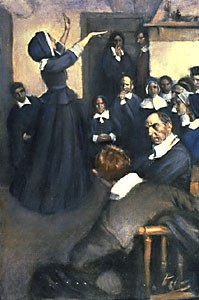
Anne Preaching
The religious climate in the Massachusetts Bay Colony was oppressive. As the colony took hold, ministers emphasized everyone's pious duty to pray, fast and discipline oneself. Noting that the male members of Boston's church met regularly after sermons to discuss the Bible, she started to hold similar meetings for women in her own home. At first the women discussed the previous Sunday's sermons, but before long Anne began telling them of her own beliefs which differed from those of the Boston ministers. She attracted hundreds of women - aided by her reputation as a skilled midwife - and men, too, soon joined her discussion group.
Brilliant, articulate and learned in the Bible and theology, she denied that conformity with the religious laws were a sign of godliness and insisted that true godliness came from inner experience of the Holy Spirit. Anne further exacerbated the local elders by claiming that only two Boston ministers were "elect" or saved, John Cotton and her brother-in-law, John Wheelwright.
Anne's weekly meetings took on a new importance. As many as eighty people filled her house, including "some of the magistrates, some gentlemen, some scholars and men of learning." Among them was Sir Henry Vane, who became governor of the colony in 1636. When Anne, with the aid of Governor Vane and John Cotton, attemtped to have her brother-in-law, John Wheelwright installed as minister of the Boston chuch, most of the congregation supported her. But the pastor of the church, Reverend John Wilson, gave a speech on the "inevitable dangers of separation" caused by the religious dissensions, and joined with John Winthrop in opposing her.
What started as a religious point of difference grew into a schism that threatened the political stability of the colony. To her opponents, questioning the church meant questioning the State. Anne's ideas were branded as the heresy of "Antinomianism" (a belief that Christians are not bound by moral law), and her followers became known as "Antinomians". Intended to be derogatory, the term was erroneously applied to Anne's followers, who did not believe that the inner Holy Spirit released them from obligation to moral law.
The colonial government moved to discipline her and her numerous followers in Boston. In May 1637, Vane lost the governorship to John Winthrop. To prevent new Antinomians from settling, he imposed a restriction on immigrants, among them Anne's brother and several of her friends. In August, eighty-two "heresies" committed by the Antinomians were read at a synod, and a ban was placed on all private meetings.
But Wheelwright continued to preach and Anne now held her meetings twice a week. In November, Winthop appearing before him, and though I must come to New England, yet I must not fear nor be dismayed," she said. "Therefore, take heed. For I know that for this that you goe about to doe unto me," she threatened, "God will ruin you and your posterity, and this whole State." Winthop immediately replied, "I am persuaded that the revelation she brings forth is delusion." The court voted to banish her from the colony, "as being a woman not fit for our society".
Anne on Trial
Wheelwright was exiled and shortly left for New Hampshire while Anne was put under house arrest for the winter to await a church trial in the spring. On March 15, 1638, Anne was brought to trial before the elders of the church of Boston. When her sons and sons-in-law tried to speak on her behalf, John Cotton cautioned them against "hindering" the work of God in healing her soul. To the women of the congregation he said to be careful in listening to her, "for you see she is but a woman and many unsound and dangerous Principles are held by her."
Once her friend, Cotton now turned full force against her, attacking her meetings as a "promiscuous and filthie coming together of men and women without Distinction of Relation of Marriage," and accused her of believing in free love. "Your opinions frett like a Gangrene and spread like a Leprosie, and will eate out the very Bowells of Religion."
Then Reverend Wilson, whom she had once tried to evict from the Boston church, delivered her excommunication. "I doe cast you out and in the name of Christ I doe deliver you up to Satan, that you may learne no more to blaspheme, to seduce, and to lye."
"The Lord judgeth not as man judgeth," she retorted. "Better to be cast out of the church than to deny Christ."
Anne being Bannished
Banished from Boston, Anne Hutchinson with her husband, children and 60 followers settled in the land of Narragansetts, from whose chief, Miantonomah, they purchased the island of Aquidneck (Peaceable Island), now part of Rhode Island. In March, 1638 they founded the town of Pocasset, the Indian name for that locality; the name "Portsmouth" was given to the settlement in 1639. Here they established that colony's first civil government.
After William's death in 1642, Anne took her children, except for five of the eldest, to the Dutch colony in New York. But a few months later, fifteen Dutchmen were killed in a battle between Mahicans and the Mohawks. In August, 1643 the Mahicans raided the Hutchinson house and slaughtered Anne and five of her youngest children. Only one young daughter who was present, Susanna who was taken captive, survived. (Note: Many older sources insist that ALL of Anne's children except her daughter, Susanna were killed with her. This is simply not true. Sons Edward, Richard and Samuel were not present, nor were her eldest daughters, Faith and Bridget, most of whom left numerous descendants.)
The site of Anne's house and the scene of her murder is in what is now Pelham Bay Park, within the limits of New York City, less than a dozen miles from the City Hall. Not far from it, beside the road, is a large glacial boulder, popularly called Split Rock from its division into two parts, probably by the action of frost aided by the growth of a large tree, the stump of which separates the parts. The line of vision of one looking through the split towards Hutchinson River at the foot of the hill will very nearly cross the site of the house. In 1911 a bronze tablet to the memory of Mrs. Hutchinson was placed on Split Rock by the Society of Colonial Dames of the State of New York, who recognized that the resting place of this most noted woman of her time was well worthy of such a memorial. The tablet bears the following inscription:
Birthdate:
Birthplace:
Alford, Alford Parish, Lincolnshire, England
Death:
Died in Pelham Bay, Long Island, New York, USA
Cause of death:
Killed by Indians
Occupation:
Midwife, Religous Reformer; expelled frm MA in 1637, Banished from Mass Bay Colony 1638, Puritan preacher, came to New England in 1634, midwife / lay physician
ANNE HUTCHINSON
Banished From the Massachusetts Bay Colony
In 1638
Because of Her Devotion to Religious Liberty
This Courageous Woman
Sought Freedom From Persecution
In New Netherland
Near This Rock in 1643 She and Her Household
Were Massacred by Indians
This Table is placed here by the
Colonial Dames of the State of New York
Anno Domini MCMXI
Virtutes Majorum Fillae Conservant
April 1996 , In April, 1996, Anne Hutchinson was honored by the dedication of a plaque which appears in the photo. It was placed at Founders Brook Park on Aquidneck Island (Portsmouth), Rhode Island. The plaque is the work of the Anne Hutchinson Memorial Committee, a g
Some twentieth century observers credit Anne Hutchinson with being the first American woman to lead the public fight for religious diversity and female quality. In his 1971 biography, Eleanor and Franklin, Joseph P. Lash reported that Eleanor Roosevelt began her list of America's greatest women with Anne Hutchinson. Anne did indeed use her considerable influence as a woman to test the Massachusetts Bay Colony's religious tolerance which, ironically, had been the reason for the settlement.
We have lost the art of communicating with romantic and flowery words, whether it be through a love letter or an obituary. Technology has made it so much more convenient to pick up a phone, type a text message or send off a quick e-mail. Sad don't you think that we now find it difficult to express our true emotions on paper? These words, our ancestors knew.
A Love Story-March 8, 1823
Jack wrote a love letter to his wife Florence, he called her Billy. He had no idea at this point-in-time that he would never see her again.
Dearest Wife:
Florence Eloise Sterling
my grandmother
Billy dear, now that you've gone I realize how much I really love you. Dear girl, I'll never forgive myself for letting you go. Dearest, this room doesn't seem the same. I used to think it was so cozy and cheerful but now it seems so cold and bleak and dreary. Our kitchenette room is too full of memories of you. I see you at the gas range, I imagine I see you by the dresser curling your hair. The only thing that consoles me is the realization that you will soon return to me. And when you do, God knows how I'll stand it until then, you can gamble your last dollar that you won't leave me again.
Dearest, I want you to rest and enjoy yourself while you are there. I won't ask if you had a safe journey as God couldn't be so cruel as to make it otherwise.
Well, dearest one, will close now hoping that you miss me as I do you. A wealth of love and a fortune of kisses from
Your lonely husband, Jack
Merl G. Eldridge, age 21, worked in the National Powder Company plant, a dynamite factory, located in Eldred, PA, just over the New York border. An explosion took place at about 8:50 a.m. on Thursday, October 18, 1939, in a stone building used as a mixing plant where nitroglycerin was made.
He was the son of Everett Eldridge publisher of the Eagle Tribune, and Beatrice Hatch, nephew of my great grandmother, Elsie Eldridge Sterling.
The Monday morning before he was to be married he didn't want to go to work. His mother, Bea, told him you might as well go to work - you're getting married soon - so he went to work.
The explosion that killed five blew the men to bits. Only a lock of Merles' hair was found.
Merl was to be married to Clarice Preston of Syracuse, NY. the following Sunday. His funeral took place in the church and on the day on that his wedding was to take place. His fiance showed up for the funeral wearing her wedding dress.
My great-grandmother, Elsie Lovina Eldridge Sterling, I called her Gram, lived in a cottage on the hill in Bonaventure, Florida that sat just on the outskirts of Cocoa. She was born on August 22, 1870. She would always bake cookies for me. When I was three, I would press my little nose on her screen door and ask, "Can I have a tookie, please"? Of course she always gave me one. She loved me, I knew that, and I loved her too. Today I realize how blessed I was to have known her.
On the back side of her cottage was a very small, screened-in porch. I would sit in one of the chairs on the porch with her and she would play Chinese checkers with me for hours as she told me stories of her and gramp when they dated in the horse and buggy days. She had long chestnut hair that even when it turned gray, she would braid every morning and wrap them up and over her head. Her laugh was somewhat of a giggle. Gram was a gentle soul.
Today, I have a necklace made from her chestnut hair, three strands, each braided in its own unique design. In the middle hanging from a gold clasp is a polished chestnut sea bean. The beans are found on the Florida beaches when they wash up from some Caribbean island. I feel close to her whenever I wear it.
Elsie Eldridge and Emond Sterling
Gram, Gramp and Me
I remember her washing my hands in her kitchen sink when I was a very little girl. She would wrap her hands around mine and gently wash them. Her hands felt as soft as a newborn baby blanket. They were wrinkled with blue veins and gnarled with arthritis, yet they made me feel safe. These beautiful hands trembled with age, but, despite this she taught me how to crochet. Later, I crocheted the edge of a white hankie in mint green and gave it to her. After she passed, I discovered that hankie, worn so very thin from use, but still in tack. Hands such as hers represent grace, beauty and love.
Gram loved birds and they loved her too. She would go out on her front stoop to feed them. They would actually eat from the palm of her hand. They waited for her each and every day. While sitting in the screened porch, as we did quite often, the birds flew around to the back of the cottage and they began to call out to her quite loudly. "Okey" she said, "I'm coming". She was late going out to feed them. As she stood up, they flew back to the front of the cottage to wait for her. She would call the blue jays little pigs, because they would try to eat all the food as they attempted to chase the smaller birds away. But, she wouldn't let any bird no matter how small get away without their fair share.
She passed away in 1961, living to the age of 91. She and gramp were cremated and laid to rest beneath the Mulberry tree located in the front yard of the cottage that sat on the hill. Years later, they were reverently moved and laid to rest at the foot of the casket of their daughter Florence and her husband Scott. No marker makes known that they are there.
Up until a few years before she passed she could still touch her toes without bending her knees. Because of her, I learned to appreciate and understand that just because you're growing older, doesn't mean you can't be young at heart and live a full life. I aspire to be as gracious as she.
She was wise enough to leave behind in her handwriting genealogy notes that proved to be invaluable to me in reseaching and building our family tree. One name she wrote down as follows: "Ann, as in history". She was referring to Anne Marbary Hutchinson (my 9th great grandmoter and her daughter Susanna who married Lieutenant Thomas Eldred, my 8th great grandparents.
Thank you Gram. It is wonderful to have this history written in your handwriting, listing your parents, grandparents, your great grandparents, but also your 2nd, 3rd and 4th great grandparents as well. This information informed me when the name went from Eldred to Eldridge.