Learning from the past, living in the moment, and leaving footprints for the future. Stories of lov

Tuesday, July 24, 2012

Capt Eli Pierce & Family

Rock Village RR Station


I had been looking for Eli Pierce and his wife Fidelia Rider (3rd gr grandparents) for some time.  I knew that they had lived in Rock Village, Middleboro, MA near the railroad station for their son Thomas Warren Pierce (2rd great grandfather) was born there.


Church at Highland Street Cemetery

 I found a cemetery on Highland Street that had my 4th and 5th great grandparents; that was exciting to find, but no Eli or Fidelia.  The family surely attended church here.  Sadly, the church was struck by lightning and burned to the ground.  A new church was built near where the old railroad station was.

So now I was on the hunt for the missing 3rd set of grandparents.  Fidelia was the link that led me to nine grandfathers that came over on the Mayflower.  So she alone was a very important person for me to find.

Eli Pierce and other generations of the Pierce line were all men with wonderful  military histories.  Eli  was commissioned lieutenant of a company of militia in Middleboro's south part, May 18, 1824, and captain on May 11, 1827, in the regiment of Col. Benjamin P. Wood, of Middleboro, 4th regt. of 1st brigade, 5th Division.

I next searched in Rochester, the next town over for one full day to no avail.  I then discovered they had moved to Rochester and Fidelia died there and was buried in Acushnet.  I chose the cemetery closest to the Rochester line, Long Plain Cemetery, Circa 1800.  This is where I found not only them, but others were noted on this gravestone that is taller than me.

Here I discovered their son Eli Wilson who was named after Fidelia's brother Wilson, and who was a minister.

 His wife Annie A (Slocum)  is here with a dedication to her on the back of this tone that reads:
"Weary hands lay still and rest folded oe'r a lifeless breast. God these hours of toil will bless, He will give thee sweetest rest"

Eli and Fidelia's son Nathaniel is there, named for Fidelia's father. This son was a clerk in the town of Rochester and at the age of 20 died of Typhoid fever.  Son Samuel who is listed here worked for years in his brother's, Thomas', hardware store in the town of Middleboro.
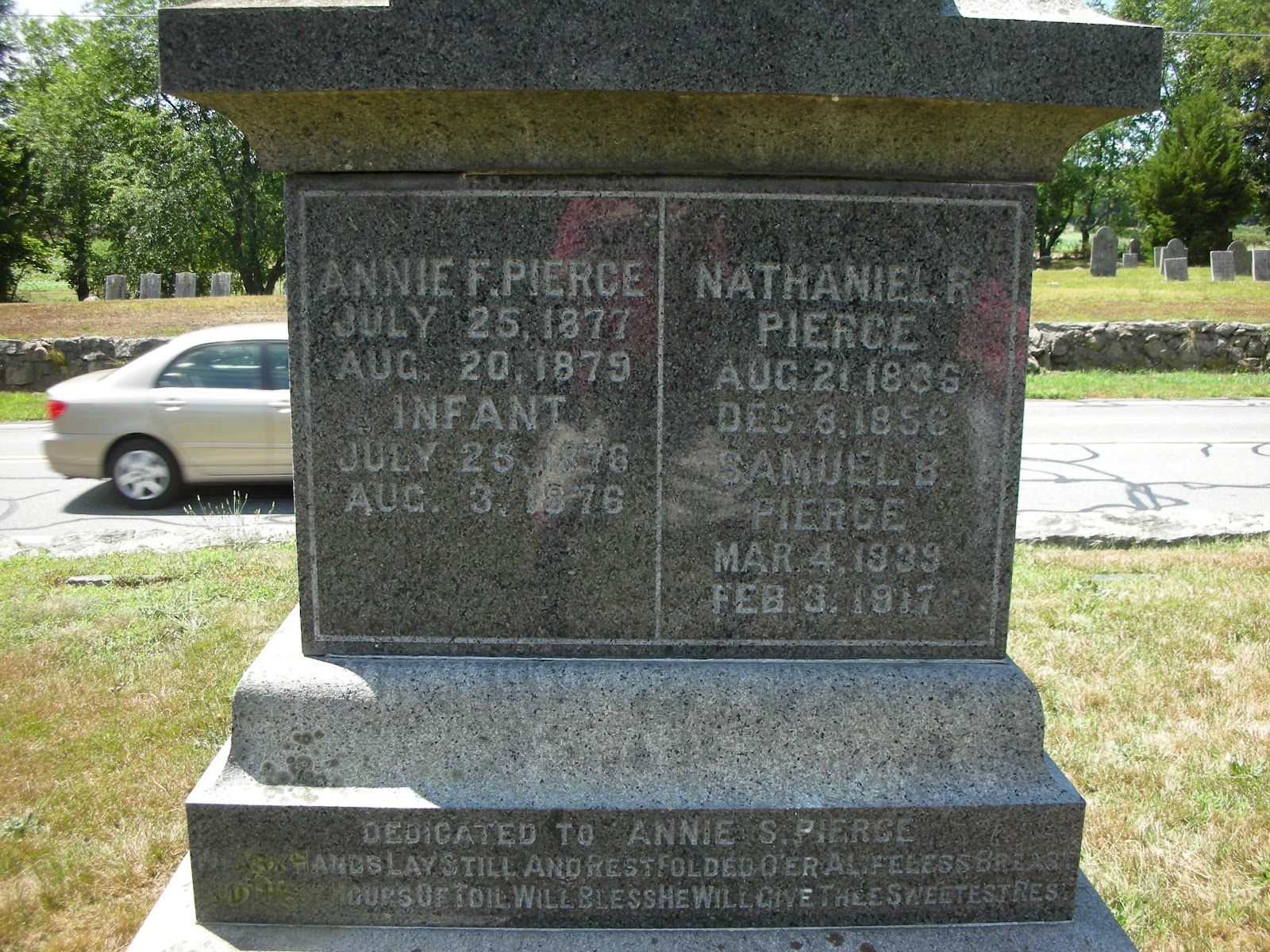
Now we have an Annie F and an infant that I have yet to connect.  That mystery will be solved another day.

Monday, July 23, 2012

Lieut John Tomson

John Tomson, of  Dutch origin, came to Plymouth in 1622 at the age of six.  He was a prominent first settler of Halifax, Ma.  He grew to be 6’3” tall, a very unusual stature for this period in time.

Sight of  log home
 burned down by the Indians in 1675
He married Mary, daughter of Francis Cooke, who arrived on the Mayflower in 1620. Being a carpenter, he built a log home, the first to be built in Halifax, Massachusetts. It was here that they suffered greatly. The Indians that surrounded them would continuously threaten them and steal their cattle and crops. 

One frightening episode happened while Mary was cooking fish in her kettle.  The Indians forcibly entered the home brandishing a knife over her in an attempt to steal the fish. Mary fought back the attack with a splinter broom and drove them away. This was only but one incident of many for the family was in constant peril.

History tells us that they were heading to church one Sunday morning when John spied a large gathering of very angry looking Indians.  He made the decision to return home and quickly gathered their valuables and left.  They warned a neighbor, but he refused to leave.

Once down the road about two miles, John looked back and saw flames and smoke.  The Indians burned their house to the ground in 1675. This was at the beginning of the King Phillip’s War.  Their neighbor’s house was also burned to the ground and he had been killed.  John received the commission of lieutenant and commanded a company of 16 men.  


John died on June 16, 1696.  He and his wife Mary, my 7th great grandparents, are buried in Nemasket Hill Cemetery in Middleboro, MA up high on a hill.  His gravestone reads:

In Memory of
Lieut. John Tomson who Died June 16th ye 1696
In ye 80 year of his age
This is a debt to nature due,
Which I have paid and so must you

Friday, July 20, 2012

Royal Beebe-Declared Incompetent

 Royal Beebe was raised on Beebe Hill in Cuba, New York. Beebe Hill was named by its first settler, Jeremiah Beebe, Royal's father, in 1829.  Jeremiah settled on a farm east of Cuba village in 1829 and died there.  

At the age of 20, a farmer by trade, in the year 1835 Royal married Mary Ann Woodward, my 3rd great grandparents. They had nine children.  In 1867 the family moved to Golden, Oceana, Michigan. In 1890, Royal had an accident from which he never fully recovered.  What the accident was is not known. (Working some years ago at a company that insured farms I do know that accidents occuring on farms can be horrific.) 

Two years later in the month and year of November 1892 the court appointed his son Alfred Royal, age 30, his guardian and given full power to administer his father's estate.  Royal at the age of 78 was declared incompetent.  His son stated that his father had lost his memory and was incapable of transacting his own business.  He didn't realize the value of money or property and needed someone to  see to the preparation of food, clothing and care.

Two months later, Royal died on January 7, 1893 leaving an estate of 40 acres, livestock, equpment and a detailed list of assets for a total alue of $1466.25.  Four of Alfred's sibling contested their father's will stating that he was not in his right mind when he signed it on October 9, 1892.  The will was signed by three non-family  witnesses.  The outcome is unknown.  


Obituary


Wednesday, July 18, 2012

Robbing the Cradle


Buried together
in the Tomson Cemetery
Halifax, MA 
I just completed the Tomson branch of my family tree.  It takes me back to Francis Cooke of the Mayflower.  The Tomson family I find extremely interesting as well and will share more information in upcoming posts.  This story I found amazing.  I always heard the term "Robbing the Cradle", perhaps this is where it started.

The Tomson Cemetery is located about three miles from where I live.  I have been there but didn't have my camera with me.  I broke my first rule, "Always carry camera in car".  So now I need to visit once again to get the picture of their gravestones. Thomas Tompson and Mary Morton are my sixth great grandparents.

Thomas Tomson (also spelled Thomson and later Thompson) was a close acquaintance of John Morton who advised his friend, when the latter turned 25, that he should soon marry as he was of the proper age. Thomas is alleged to have replied, "I will marry that daughter of yours when she is old enough," pointing to John Morton's infant daughter Mary in her cradle.  John is not known to have objected, and when Thomas was 50, he made good his word, marrying Mary, aged 25. They married on December 13, 1715 in Middleboro, Massachusetts.

Thomas was a farmer and a glazier, and set diamond glass in lead, a feature of windows common in those days.

Thomas inherited 700 acres from his father, and he and Mary lived in the original house built by John Tomson following King Philip's War and the burning of the first Thomson home in Middleboro, Mass. They had seven children.

Sources: Ignatius Thompson, Genealogy of John Thompson (1841) and Charles Hutchinson Thompson, Genealogy and Descendants of John Thompson (Lansing, Michigan: 1890).

Monday, July 2, 2012

What Keeps Me Going


Arodi Peirce 1825
 The definition of genealogy is the study or investigation of ancestry and family history.  Sounds simple enough doesn't it?  Not everyone understands this concept or the deep emotional connection we feel when we uncover just who our ancestors are.  Some people just can't think past the grave and dead people. Those of us who have been researching and studying this thing called genealogy have been rewarded a thousand times over. 

I believe there comes a time in life when you realize how important it is to document your family history.   Slowly this endeavor becomes more than just names and dates.  You uncover lessons of faith, patriotism and love.  You learn about the struggles they underwent during wars, the depression and the loss of loved ones through illnesses we can cure today. 

I enjoy the hunt for the twists and turns and uncovering surprises that at times delight me and yes sometimes even shock me.  Studying and learning about your ancestors can teach you tolerance of others. Here you may find multiple faiths in your family tree along with a possble black sheep or two.  I believe that my ancestors are waiting for me to find them.

You begin to understand that you are a composite of all those who came before.  You come to the realization that one day you will be part of all those yet to come, therefore your life continues through them. What keeps me motivated is the realization that when you find pictures of your ancestors, learn the details and history of their lives, it is as if you knew them when they walked the earth.  It warms my heart.

Saturday, June 30, 2012

Walter Christian Roesch - A Veteran Surprise


Walter as a young man
with his parents,
Julia and Clyde Roesch
 Walter Christian Roesch was born in Potosi Village, Wisconsin on August 9, 1925.   It was in October 2008 that I learned that he was in Heartland Nursing Home in Platteville, Wisconsin, not recognizing anyone.  He passed away this past January 28, 2012 at the age of 86.  He was the grandson of Philip Roesch who served in the Civil War.  Walter never married and never had children.

Walter is remembered as a young boy carrying his violin to school as he took music lessons.  He spent many months in Eau Gallie Florida as a child with his parents in a cottage on Highland Avenue.  His father, Clyde, purchased it from his brother, William Russell Roesch, Mayor of this charming town.


After graduation from Potosi High School, Walter attended Bayless Business College in Dubuque, IA. During World War II, Walter served in the U.S. Army. He worked as an administrative assistant at the Potosi Brewery. Walter later worked at the Civil Defense Office in Lancaster until his retirement. He was a member of the Davies Memorial United Church of Christ, where he played the organ for over 40 years.

Five months have now passed since Walter's death.  Then a surprise came to me on June 22, 2012 in the form of a message waiting for me on ancestry.com.  It read: 


My name is John C. and I work for the Department of Veterans Affairs in the Memorial Programs Service and have received an application for a marker for Walter C. Roesch. Unfortunately there is a requirement that a next of kin signs the request in order to issue the marker. If you wish to be of help in this matter, please contact me at 888-101-1111 ext 111. Regards,

I immediately called John.  It seems a veterans agent in Wisconsin had called him about the situation for he said that Walter had no next of kin.  John told me that when these situations arise he researches ancestry.com to see if he can find a relative.  This is how he found me.

I was overwhelmed with emotion and so grateful for the opportunity to do something so very special for Walter. 


Monday, June 25, 2012

Voicing His Opinions.

Observations By An Observing Observer is a column my grandfather, Wm. Phillip Roesch wrote in 1925 in Eau Gallie, Florida.  Here is a small collection of his witty, subtle, and sometimes cutting  remarks to voice his opinion.

A few years ago the greatest preventive known to fond moments for Old Maidism was a partly concealed, well oiled porch swing - now replaced by the rumble seat in a sport modeled roadster.

It requires more time and attention to raise a crop of "wild oats" than one would imagine - and then the crop is worthless.

Over in Tampa the police threatened to jail two girls for appearing on the street without stockings - straining at a gnat and swallowing a horse fly - as it were.

If you want to find a prosperous town, find one where the Dove of Peace is a permanent resident.

Miami has a new method of showing police officials that the public is really their boss, by trying a few of 'em om ordinary murder charges.

Suggested slogan for the Garden Club:  "Make your house look like a home - plant flowers."


Strange as it may seem, you never see a checker game going on in the store of a consistent advertiser.

Thursday, June 21, 2012

A WWII Hero Dies


I am re-posting this story today, for John Walter Wyman passed away last Thursday. He was a truly loved man by not only his family but by the community as well. We drove the four hours to Rumford, Maine to attend his services that were held on June 20th. Thank you for your gallant and brave service. Rest In Peace.

John was an easy going man, a true hero from WWII.  He raised his four children not by lecturing, but by only two rules, "I won't take you to the hospital, and I won't bail you out of jail."  Another words, stay out of trouble.  He and his wife Rita would have been celebrating 70 years of marriage on July 7th.

John W. Wyman was a gunner in the World War II airplane in this photo.  Squadrons were assigned to fly a maximum of 25 missions over Germany, after which they would be replaced by new forces.  Few made mission 25, but John's squadron did, only to be told that they would need to fly one or two more because their replacements had not yet arrived.  Mission 26 was a success, but on mission 27 they took fire and the pilot was shot and killed.  Their options were few: parachute out or go down with the plane.  John scrambled up into the fuselage of the craft from his perch suspended in its underbelly.  As they looked out the windows, they saw others from their squadron who had jumped, their chutes being riddled with holes as they were fired upon as target practice. The choice quickly became clear when the co-pilot of John's plane said he believed he could land the craft on its belly, so the crew opted for riding it down, which they did safely and quickly abandoned it on foreign soil.  Years later, this photo of the downed aircraft was sent to John's family by someone from Germany.  The family put his photo on it and the words to the rally song "Wild Blue Yonder".

John's plane was shot down and he was taken prisoner. 

 He was moved from one camp to another during one of the worst snowstorms in history known as the "Black March".  Many died but John survived with only a blanket.

From Wikipedia:

The March" refers to a series of forced marches during the final stages of the Second World War in Europe. From a total of 257,000 western Allied prisoners of war held in German military prison camps, over 80,000 POWs were forced to march westward across Poland, Czechoslovakia, and Germany in extreme winter conditions, over about four months between January and April 1945. This series of events has been called various names: "The Great March West", "The Long March", "The Long Walk", "The Long Trek", "The Black March", "The Bread March", and "Death March Across Germany", but most survivors just called it "The March".

Thursday, June 14, 2012

Yoo-Hoo Dinner Is Ready

My Nannie's Potholders

My dad always received his vacation the first two weeks of July.  There was always so much excitement as my mother packed our suitcases to hit the road down the old US route 1 highway heading toward my maternal grandparents who lived in Rockledge, Florida. 

The drive was filled with anticipation and lots of questions such as "Where are we now"?  We always drove straight through. Mom always packed a cooler with sandwiches, drinks and snacks to eat.  Dad only stopped when he needed gas or the very important potty stop, lots of those with four kids in the car. My three sisters and I in the back seat did all sorts of contortions to find a comfortable place to sleep, i.e. legs on top of each other and even one of us ended up on the floor sleeping.  No seat belts back then.

Of course when we got close to our destination we recognized the familiar sights we have seen so many times before and soon we would be at my grandparents home, where we knew fun and spoil city lived.

I remember my grandmother Florence, whom we called Nannie. She always served ice tea at lunchtime with cold cuts to make sandwiches and slices of cantaloupe and other good stuff to enjoy. It was very hot there in July so cold food for lunch was always an enjoyable meal. We sat at a table in a very large dinning room that was once utilized as a restaurant. She was a very good cook and at one time had many faithful customers, especially truck drivers hauling their goods down route 1 known as the Old Dixie Highway.

Dinnertime we enjoyed good old southern fried meals cooked in a hot kitchen with potholders and dishtowels hanging nearby. Whether it was steak with gravy and peas or chicken and gravy and always lots of mashed potatoes with corn on the cob with ice-cold juicy watermelon for dessert. Always delicious and fun to all be together.

Our Nannie made her own potholders and if you look closely you can see the fruit and flowers that she cut out and applied, and then crocheted around each item and around the eyes and mouth of the faces she so carefully made.  It's fun to look at them and remember her.

Related Posts Plugin for WordPress, Blogger...